
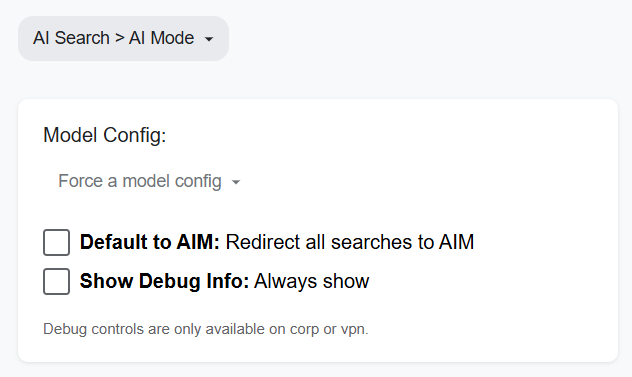
During our research, we stumbled upon an unexpected discovery: an employee‑only debug menu that lays bare the scale of their AI projects. Tom Critchlow had already encountered an earlier version of this menu last March, but the new iteration now boasts 48 additional items – while 11 have vanished. We also uncovered a complete list of live search‑engine experiments, 55 of which are directly tied to AI. Together, these findings offer a rare window into the Mountain View giant’s AI strategy.
A Window into Google’s Secrets
Imagine being able to peer over a Google engineer’s shoulder as they test upcoming search‑engine features. That’s exactly what happened when we discovered this debug popup, accessible only through the AI Mode interface – “on corp or VPN,” meaning on Google’s internal network or via their corporate VPN.
The first thing that strikes you while browsing the menu is its structure: it’s divided into several distinct categories. At the top sit different models, followed by specialized AI projects, internal tools, and finally a series of assistants whose names are sometimes enigmatic.
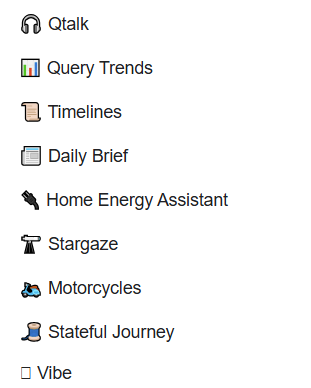
This debug interface exposes nearly 90 AI projects currently in development.
You can explore the reconstructed interface here to grasp the full scale of the system : https://i-l-i.com/google-ai-mode-debug-menu.html
The Revealed Architecture: A Multi‑Agent Strategy
Specialized Assistants: Google’s Secret Army
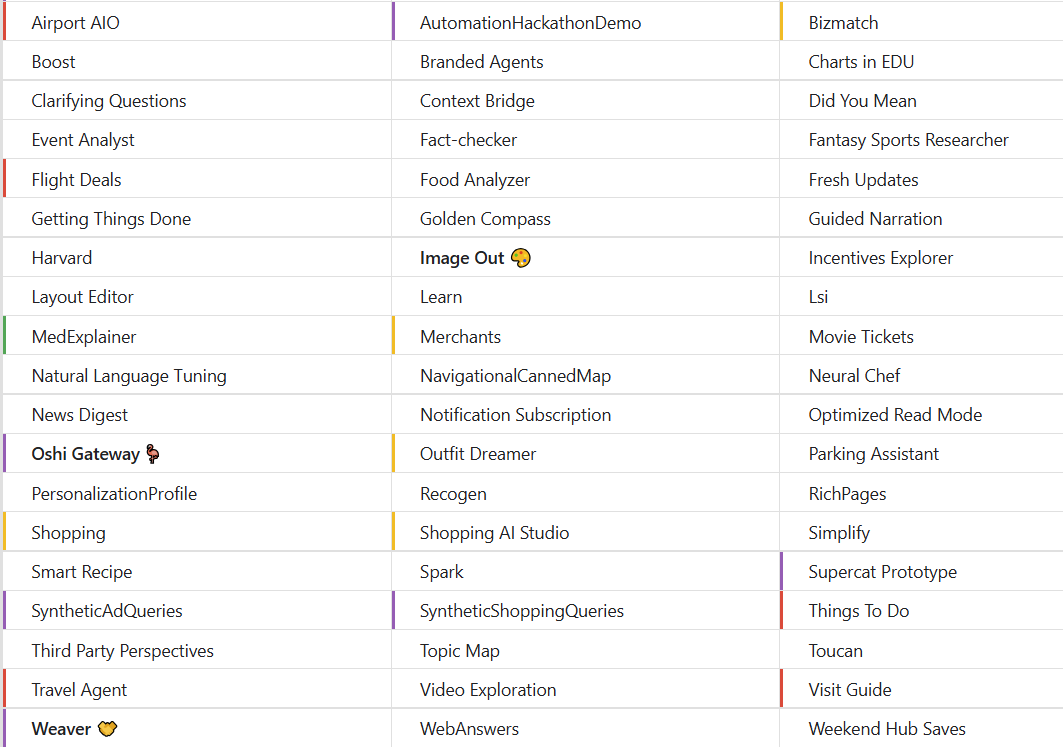
The menu points to a deliberate approach: instead of a single, all‑purpose assistant, Google is building a constellation of ultra‑specialized AI agents. A few emblematic examples:
- MedExplainer – In the sensitive YMYL (Your Money Your Life) domain, Google appears to be training an AI specifically to deliver reliable medical information and explain complex health conditions.
- Travel Agent & Flight Deals – Far beyond basic flight searches, AI agents will soon be capable of planning entire trips.
- Neural Chef, Food Analyzer, and Smart Recipe – Three separate culinary projects, hinting at a sophisticated approach to kitchen assistance. Food, travel, and general “how‑to” verticals were among Google’s earliest AI focus areas.
- News Digest & Daily Brief – two new news‑oriented projects, arriving just as the first AI‑generated summaries have landed in Discover.
- More new projetcs designed to help users in their everyday lives like Movie Tickets, Parking Assistant, Things To Do
- A particular focus on learning and education with Learn, Charts in EDU, Harvard
Some projects map directly to interface features—such as the “About This Image” modal, the disambiguation functions “Did You Mean” or “Clarifying Questions,” and the well‑known “WebAnswers” already present in the classic SERP.
Others will delight semantics‑minded SEOs: LSI, Natural Language Tuning, Supercat Prototype, Topic Map,
and many more :
The Shopping Ecosystem: Google’s True Battleground
A striking number of projects are commerce‑focused:
- Shopping AI Studio – Builds personalized shopping experiences.
- Bizmatch – Smart B2B matchmaking?
- Merchants – A dedicated interface for sellers?
- Outfit Dreamer – Virtual try‑on tool.
- Flight Deals and Movie Tickets – Specialized verticals.
This concentration underscores Google’s clear monetization strategy in e‑commerce, steadily turning the search engine into an intelligent transactional platform.
Experimental Innovations: Google’s Future Lab
Some projects bear enigmatic names that hint at bold experimentation:
- Oshi Gateway 🦩 – The flamingo icon suggests something sleek and elegant – perhaps a gateway to premium services or a revolutionary interface.
- Weaver 🤝 – The handshake emoji evokes interconnection, possibly a system that unifies all the other agents.
- Supercat Prototype – A mysterious name that could hide a major breakthrough, perhaps tied to ultra‑advanced contextual categorization, in the vein of Google’s Petacat project.
Also noteworthy are SyntheticAdQueries and SyntheticShoppingQueries, which likely train classifiers or run tests using AI‑generated queries – exactly the sort of technique search‑visibility specialists are experimenting with in today’s LLM landscape.
The Magi Experiments: The Beating Heart of Google’s AI
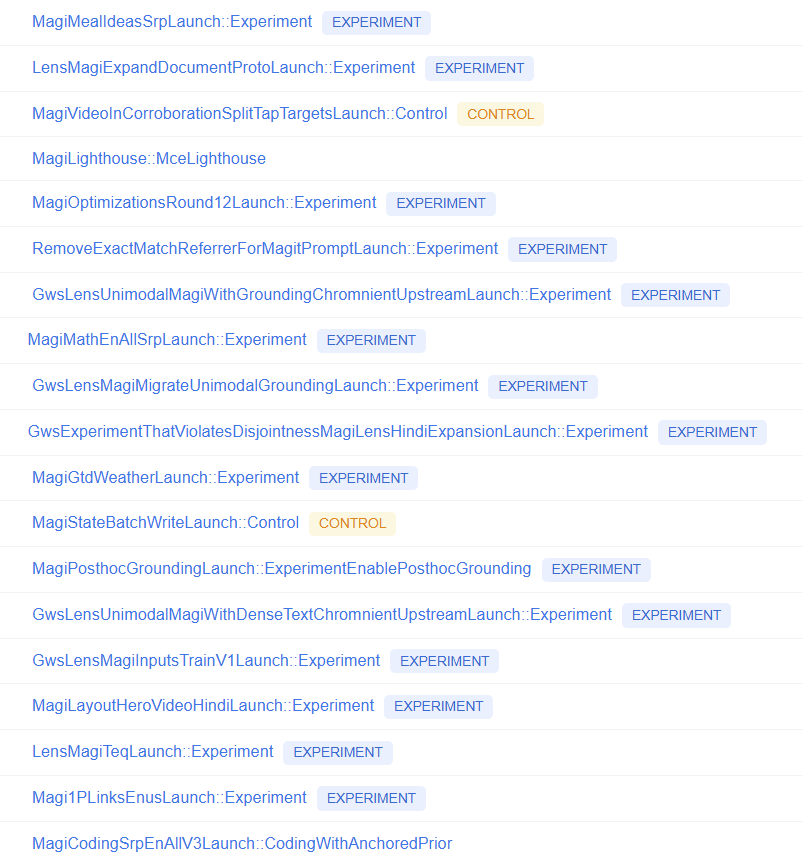
In parallel with this discovery, our investigation uncovered an impressive roster of active experiments – over 50 of them tied to “Magi,” Google’s code name for integrating AI into Search.
Decoding the Magi Architecture
Magi emerges as the central system, with more than 50 active experiments arranged in several layers:
Base infrastructure
- MagiModelLayerDomain (796955) – The markedly different ID suggests a fundamental experiment, likely the core architecture on which everything else relies.
- MagitV2p5Launch – Apparently version 2.5 of Gemini.
- SuperglueMagiAlignmentLaunch – “Superglue” echoes the Glue system revealed in the 2024 leak for tracking user interactions across Universal Search; this experiment is probably designed to carve out space for AI Overview results.
Heavily tested specialized verticals
- MagiTablesLaunch and MagiMathCacheLaunch – Experiments dedicated to structured‑data handling and mathematical calculations.
- MagiMealIdeasSrpLaunch – Direct integration on search‑results pages for meal‑idea queries (SRP = “search‑result page” in Google’s lexicon).
- MagiGtdWeatherLaunch – Contextual weather information.
- MagiCodingSrpEnAllV3Launch – A coding assistant already at version 3!
A Controlled Roll‑Out
Experiments such as “MagiSrpRestOfWorldLaunch” show that deployment is being phased in by geographic region.
We also see trials aimed specifically at the Indian market, where AI Mode is already active, just as it is in the US:
- GwsLensMagiHindiExpansionLaunch – Hindi‑specific tests.
- MagiLayoutHeroVideoHindiLaunch – Video‑layout adaptations for the Indian market.
AIM: The User Interface of the Future
Beyond Magi – the backend, Google is developing AIM (AI Mode) as the front‑end experience, with more than 15 active experiments underway.
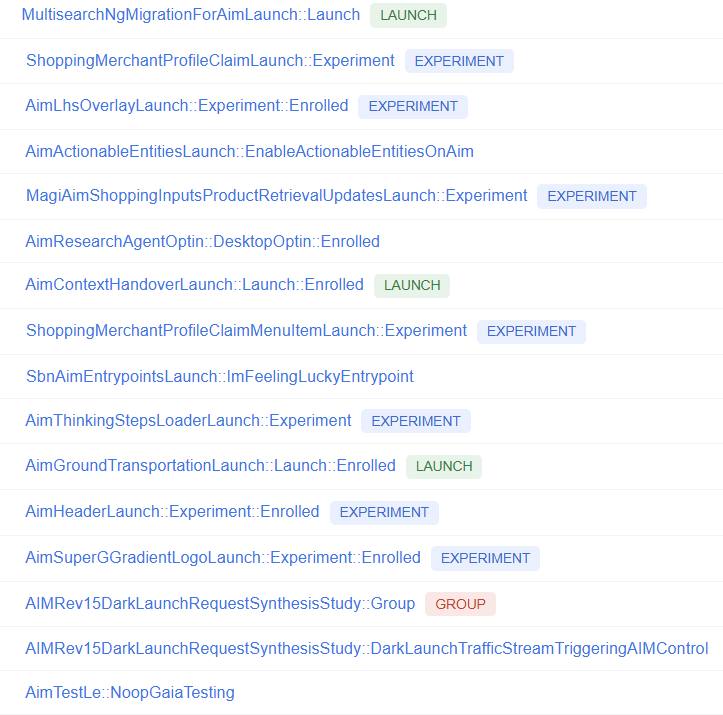
Multiple entry points
- AimLhsOverlayLaunch – an AI sidebar
- SbnAimEntrypointsLaunch::ImFeelingLuckyEntrypoint – the classic “I’m Feeling Lucky” button turned into the AI Mode entry
- AimSuperGGradientLogoLaunch – even the Google logo becomes interactive
Transparency and understanding
- AimThinkingStepsLoaderLaunch – real‑time display of the AI’s reasoning
- AimContextHandoverLaunch – hands off context between queries
The Chain‑of‑Thought revolution
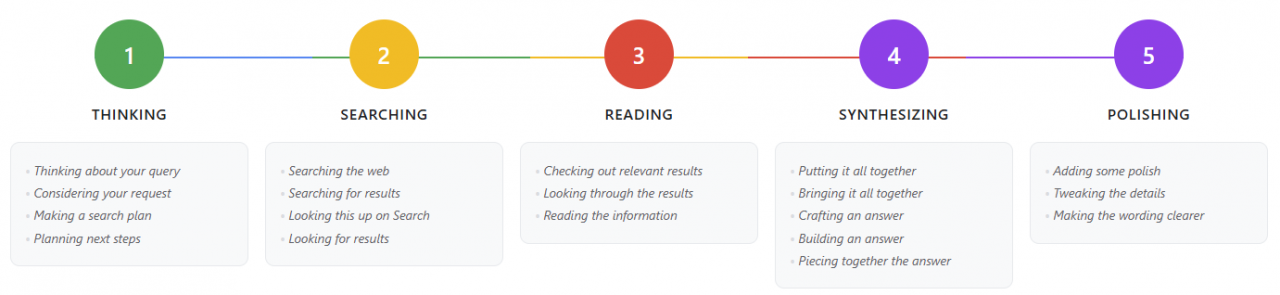
The MagitCotRev15Launch experiment warrants special attention. “CoT” stands for Chain of Thought – a method where the AI reasons step by step. Reaching revision 15 already suggests this feature is highly advanced.
Here are the five reasoning states of AI Mode, as exposed in Google’s code:
Reflection → Research → Reading → Synthesis → Polishing
Implications for SEO and the Future of Search
A New Era of Search
Google no longer merely indexes and ranks pages; it is becoming an orchestrator of specialized AI agents, each an expert in its own domain.
For SEOs, the consequences are significant:
- Hyper‑specialization is now critical: With agents like MedExplainer or Neural Chef, your content must demonstrate indisputable expertise in precise niches. The leaked siteFocusScore and siteRadius metrics suddenly make perfect sense.
- Multimodality is no longer optional: Projects such as “Image Out 🎨” and “Video Exploration” confirm what the EQ* and TQ* scores hinted at – the age of text‑only content is over.
- User journeys have become conversational: “Stateful Journey 🧵” and “Context Bridge” show the direction search is taking: Google now tracks entire sessions, not just isolated queries.
- Personalization reaches a new level: “PersonalizationProfile” and “Vibe” go far beyond basic preferences. Numerous experiments labeled P13n (for personalization) underscore this, and – as detailed in this article – Google is also leaning on user embeddings.
Signs of a Major Shift
Some projects are labeled “Launch::Launch,” indicating they’re already in production, while others remain “Experiment.” But Google has been clear: AI Mode is set to become the company’s main entry point.
The clues converge:
- More than 50 AI experiments running simultaneously
- Systems already at revision 15 (MagitCotRev15)
- Ongoing geographic roll‑outs
- Tight integration with the existing ecosystem (Lens, Shopping, Maps, and more)
- The advertising side is not left behind, with experiments like AdsInLlmDesktop::DesktopExpansion
This deep dive into Google’s AI machinery reveals a strategy of unexpected scale. With Magi (Gemini) as the central brain, AIM as a brand new interface, and an army of specialized agents, Google isn’t planning a mere evolution – it’s a complete re‑imagining of what a search engine is.
The classic ten blue links are already relics of the past. The future will be conversational, contextual, and deeply personalized. For SEO professionals, this represents both an immense challenge and an extraordinary opportunity. Those who adapt to this new paradigm – creating truly expert, multi‑dimensional content and innovative interactive experiences – will be the big winners of this revolution.
Note : The information presented comes exclusively from publicly available sources obtained without bypassing access controls or intrusion. It is published for informational purposes only.